

The Federal Reserve Bank of New York and the Bank for International Settlements (BIS) published a joint research study that explored if and how central banks could continue to implement monetary policy operations in hypothetical tokenized wholesale financial markets.
Project Pine assumes a potential future where tokenization has been adopted for money and securities. The central bank’s role and conceptual function are assumed to remain the same and the structure of the financial system and markets looks similar.
To implement monetary policy, smart contracts are required. These contracts need to perform all the functions of a generic toolkit for implementing monetary policy (for example, paying interest on reserves, exchanging money for securities, and vice versa). In addition to performing the necessary functions, the technology should be assessed for its potential flexibility, reactivity, and robustness by using the smart contract toolkit in multiple hypothetical scenarios.
The advisers who helped shape the requirements wanted to be able to use both the standard tools and the crisis tools available today (for example, interest payments, repos, loans, asset swaps) as well as tools to manage collateral. Central bank tools require flexibility (to calibrate and add new tools easily), reactivity (to be effective immediately), and robustness (to always be available when required).
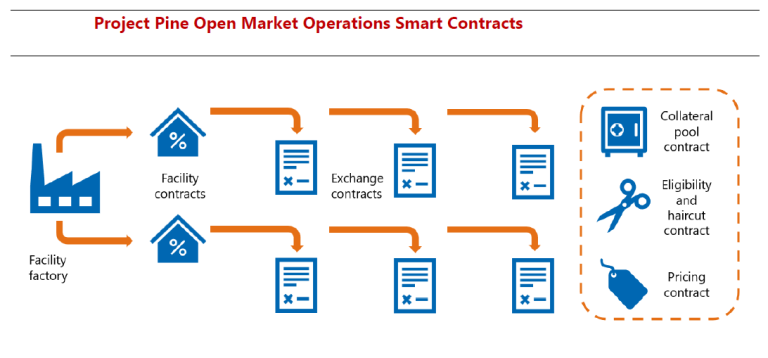
Findings showed that central banks could customize and deploy policy implementation tools using programmable smart contracts in a potential future state where commercial banks and other private sector financial institutions have widely adopted tokenization for wholesale payments and securities settlement.
The project generated the prototype of a generic monetary policy implementation tokenized toolkit for potential further research and development by central banks across jurisdictions and currencies. The prototype was designed to be technically modifiable for different central banks’ monetary policy frameworks and calibrated to conduct standard or emergency market operations.
The toolkit prototype was created in consultation with central banks’ financial markets advisors from multiple jurisdictions, who helped outline the project scope and specific design requirements. It is not particular to any currency or jurisdiction. It can fulfill a common set of central bank implementation requirements, including paying interest on reserves, open market operations, and collateral management.
The toolkit was tested against ten hypothetical scenarios simulating normal market dynamics and stress events. Each scenario was designed using historical data inputs on past market events, such as interest rate tightening and easing cycles, quantitative easing and tightening cycles, and periods of strained market liquidity or broader market disruptions.
The prototype successfully responded and instantaneously carried out the intended operation under the varying market conditions, consistent with the central bank’s desired liquidity environment. Project Pine’s findings highlighted areas for further research and analysis related to interoperability and data standardization.