
- FSB report sets out advice to authorities on how to tackle the challenges related to monitoring adoption of artificial intelligence (AI) in the financial sector.
- Report identifies a range of direct and proxy indicators to support monitoring of AI adoption and related vulnerabilities in the financial system.
- Report includes a case study on recent developments in the AI supply chain and implications of financial institutions’ reliance on a few critical third-party providers. These include vulnerabilities related to criticality, concentration, and substitutability.
The Financial Stability Board (FSB) published a report looking at how authorities are monitoring adoption of artificial intelligence (AI) and related vulnerabilities in the financial sector.
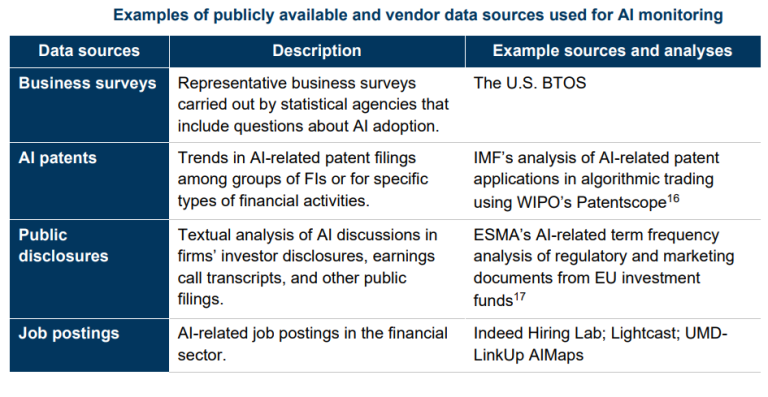
While financial authorities have made progress in understanding AI uses cases and their benefits and vulnerabilities, monitoring efforts are still at an early stage. The report highlights challenges faced by authorities, including data gaps and lack of standardized taxonomies, and identifies a range of indicators to support monitoring AI adoption and related vulnerabilities in the financial system.
Third-party service providers play a critical role in helping financial institutions develop and deploy effective AI applications efficiently. However, such relationships expose financial institutions to operational vulnerabilities, and the growing use of generative AI (genAI) could lead to critical third-party dependencies.
The report highlights the dependence of genAI on a small number of key suppliers such as specialized hardware, cloud infrastructure, and pre-trained models. This heavy reliance can create vulnerabilities if there are few alternatives available. A case study on genAI explores these challenges, drawing on the FSB’s third-party risk management toolkit and proposing indicators to assess criticality, concentration, substitutability, and the systemic relevance of third-party AI service providers.
The FSB encourages national authorities to enhance their monitoring approaches, leveraging the indicators presented in the report. To support these efforts, the FSB will facilitate alignment in taxonomies and indicators through cross-border cooperation.