

Post-trade professions are feeling more stretched than ever by the volume of mission-critical projects that are on the horizon, writes Citi Securities Services in a recent white paper. With T+1 workloads at a historical high, DLT and digital assets transforming markets such as collateral and funds, stablecoins delivering balance sheet transformation and generative artificial intelligence (genAI) offering new answers to a range of old questions, there is much that needs to be done if firms are to keep step with their peers.
2025 is “undoubtedly a pivotal year on many fronts”, with this year’s efforts likely to transform into the following dynamics in the near future, the bank wrote:
- A shift in focus on financial market infrastructure (FMI) platform transitions as part of a new business-as-usual, moving away from once-in-a-generation transitions to ongoing industry change programs
- New, competitive central securities depository (CSD) models that drive tailored solutions, capable of winning RFPs to service institutional and (neo-)retail investors
- Investments into trade cycle automation that move beyond simply removing one day from settlement cycles – enabling round-the clock trading and the processes necessary to support this (across settlements, funding, asset servicing and elsewhere)
- Increasing T+1-related workloads as markets across Europe, Asia Pacific and Africa continue to scope out and plan their own T+1 transitions, including specific nuances in each one
- New T+1-driven pressures on settlement discipline, with new solutions being put in place at regulatory and market levels to ensure >99% levels of trade settlement
- Accelerating adoption of digital money mechanisms as live payment mechanisms across the securities lifecycle, including the use of money market funds as digital money
- Widespread, live adoption of DLT and tokenization in the collateral market and in money market funds, with significant percentages of institutional turnover being managed through FMI-based platforms
- New forms of asset servicing discussions that involve a wider range of stakeholders than ever (including investment banks, transfer agents and investors)
- Advanced deployments of genAI in core areas (such as client onboarding), providing continuing insights into the opportunities and challenges of this technology in a live context.
T+1 and fails
Trade fail rates alongside affirmation rates and margin reduction were the three main ‘temperature checks’ for the success of T+1 in the US. One year on from the transition, the impact of T+1 on all of these areas has significantly lightened. Funding and margining requirements have become notably less acute (with 25% significant impact in 2025 vs 49% in 2024), as have counterparty margining costs (from 47% in 2024 to 28% in 2025),
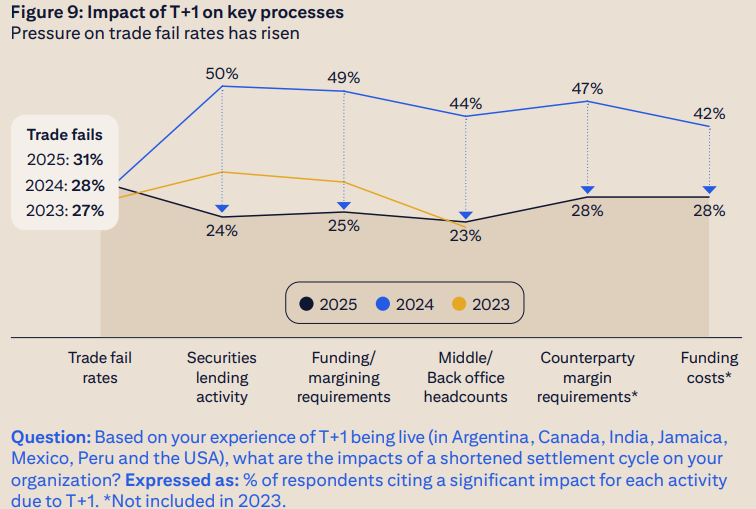
That does not mean that all pressures have receded. Although volumes of trade fails have either remained consistent or, in some cases, declined following the 2024 transitions, the pressures felt by organizations in managing those fails appears to not to be lessening over time. One year on since T+1 in North America, 31% of respondents to this year’s survey feel their organization is strongly impacted by trade fail pressures – indicating a continuing need to manage and support faster settlements across the organization, most acutely by those outside of North America.
Unsurprisingly, the industry finds minimal variance between project priorities in the UK and Europe. Both market plans focus heavily on enabling industry automation and settlement efficiency; and both set out plans for greater use of CSD functionalities (including increased standardization of SSIs and settlement instruction formats); and both provide greater clarity on deadlines for stock loan recalls. These factors are increasingly becoming common standards for T+1 plans around the world.
“Across the world, trade cycle pressures have not yet returned to pre-T+1 levels, as the pressures of settling trades one day faster continue to be felt across trade settlements, lending, funding and treasury management,” according to the report.